![B10 [2006 - 2013]](/uploads/Nissan_Almera_Classic_2006-2013_.jpg)

Tools:
- Flat stylus
- Micrometer
- Washer remover
To compensate for the thermal expansion of the valve, a clearance is structurally set between the end of the valve stem and the cam of the camshaft. With an increased clearance, the valve will not open completely, and with a reduced clearance, it will completely close.
The gap is measured with a feeler gauge on a cold (at +20 degrees) or warm engine (at operating temperature) between the camshaft cams (the cam must be directed away from the pusher) and the valve pusher adjusting washer.
For a cold engine, the nominal clearance on the intake camshaft is 0.25-0.33 mm, on the exhaust shaft 0.32-0.40 mm. For a warm engine, the nominal clearance on the intake camshaft is 0.304-0.416 mm, on the exhaust shaft - 0.348-0.472 mm.
Adjusting the valve clearance on the Nissan Almera Classic
1. Remove the top cover of the cylinder head (instructions here ).
2. Set the piston of the 1st cylinder to the TDC position of the compression stroke (instructions here ).
3. Measure with a set of feelers the clearances in the actuator of those valves, the cams of which are directed upward from the tappets. In this case, these are the valves of the 1st and 2nd cylinders of the intake camshaft and the valves of the 1st and 3rd cylinders of the exhaust camshaft. Record the measured clearance values.
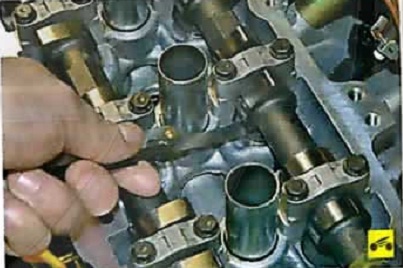
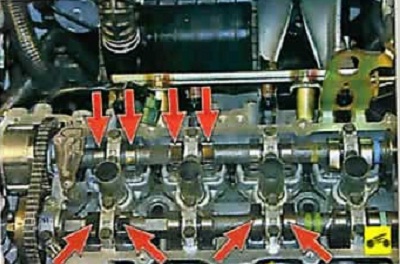
4. Rotate the crankshaft 360 ° (at TDC of compression stroke of the 4th cylinder) and measure the clearances in the actuator of the remaining valves.
5. If the clearances in the valve drive are not correct, remove the washers and calculate their thickness N using the formulas below. To remove the washers, use a special tool or remove the camshafts.
For the intake camshaft valves: N = R + (M - 0.37) mm, for the exhaust camshaft valves: N = R + (M - 0.40) mm, where N is the thickness of the new washer, mm; R is the thickness of the removed washer, mm; M is the measured valve clearance.
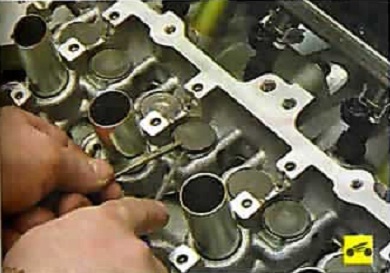
6. In order to facilitate the removal of the adjusting washer, a groove is made in the pusher. Use a screwdriver to turn the pusher by the groove so that it is convenient to pry the washer.
Note:
The back of the washer is marked with its thickness (for example, 244, which means the washer is 2.44 mm thick).
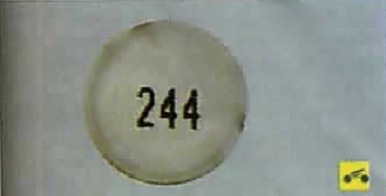
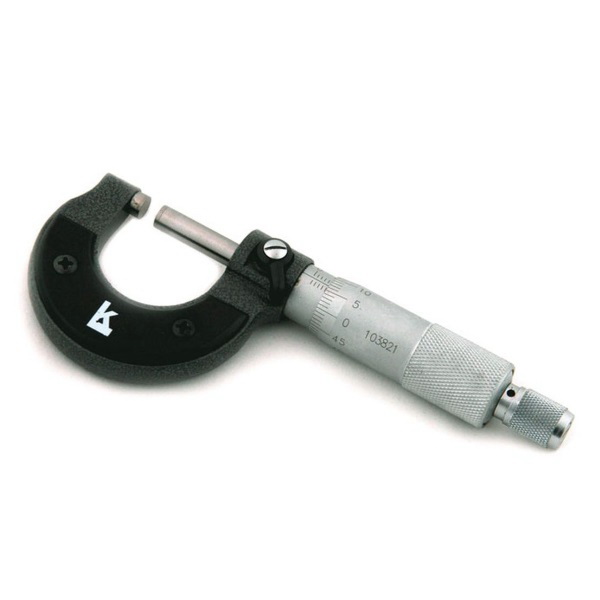
If there is no mark, measure the thickness of the washer with a micrometer. The repair kits provide 73 types of washers with a thickness of 2.00 to 2.98 mm.
7. Install new washers in the pushers, calculated according to the formula given in step 5, reinstall the camshafts and check the clearances. If necessary, repeat the operations of pp. 5 and 6.
8. Install all previously removed parts in reverse order.
The article is missing:
- High-quality photos of repair
Source: http://remont-nissan-almera.net/dvigatel/131-regulirovka-zazorov-v-privode-klapanov.html