![1 generation [2010 - 2015]](/uploads/Renault_Duster_2010-2015_.jpg)


The electronic engine control system (ECM) Renault Duster consists of an electronic control unit (ECU), sensors for engine and vehicle operation parameters, as well as actuators. The Renault Duster ECU is a mini-computer for special purposes. It consists of random access memory (RAM) and programmable read only memory (PROM). RAM is used by the microprocessor for temporary storage of current information about the operation of the engine (measured parameters) and calculated data. The RAM engine control unit takes the raw data for processing. Fault codes are also stored in the RAM.
This memory is volatile, i.e., when the power fails (disconnection of the battery or disconnection of the wiring harness blocks from the computer), its contents are erased. PROM Renault Duster stores the engine control program, which contains a sequence of operating commands and algorithms and calibration data - PROM settings are non-volatile, i.e. The contents of the memory are not changed when the power is turned off.
The ECU receives information from the sensors of the engine management system, as well as signals from the clutch pedal position sensor (vehicle with a manual transmission) or automatic transmission sensors, brake light switch, wheel speed sensors (ABS), air conditioning refrigerant pressure sensor, fluid pressure sensor hydraulic booster ECU controls actuators such as fuel pump and injectors, ignition coils, throttle valve, oxygen concentration sensor heating elements, adsorber valve, valve for variable valve timing engine 2.0), air conditioning compressor clutch, cooling fan.
The Renault Duster ECU is fixed in the engine compartment - on the back wall of the battery platform. In addition to supplying voltage to the sensors and controlling actuators, the ECU also performs diagnostic functions of the control system (on-board diagnostic system) - it determines the presence of malfunctions of elements in the system, turns on the malfunction indicator in the instrument cluster and stores fault codes in its memory. If a malfunction is detected, in order to avoid negative consequences (burning of the pistons due to detonation, damage to the catalytic converter in the event of a misfire in the air-fuel mixture, exceeding the limit values for exhaust gas toxicity, etc.). The Renault Duster ECU puts the system in emergency mode. The essence of emergency operation is to that the computer is attempting to replace readings from a faulty circuit or sensor with readings under its normal operating conditions. If the sensor fails or an error occurs, a warning lamp lights up on the instrument panel combination. At the same time, an error code is stored in the controller, which can be deleted either with a special scanner or by disconnecting the battery from the computer for 10 seconds. In any case, you can’t drive for a long time with a lit malfunction indicator, as this will affect the economy and efficiency, and, as a result, the life of the car’s engine. which can be removed either with a special scanner or by disconnecting the battery from the computer for 10 seconds. In any case, you can’t drive for a long time with a lit malfunction indicator, as this will affect the economy and efficiency, and, as a result, the life of the car’s engine. which can be removed either with a special scanner or by disconnecting the battery from the computer for 10 seconds. In any case, you can’t drive for a long time with a lit malfunction indicator, as this will affect the economy and efficiency, and, as a result, the life of the car’s engine.
Elements of the electronic engine management system 2.0 Renault Duster:
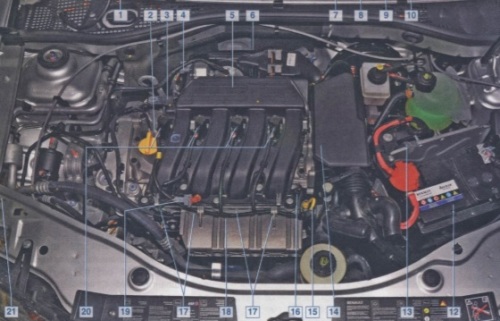
1* - diagnostic block: 2 - valve of the variable valve timing system, 3 - absolute air pressure sensor; 4 - throttle assembly control unit; 5* - control oxygen concentration sensor; 6* - diagnostic oxygen concentration sensor; 7* - gas pedal module. 8* - annunciator of a malfunction of the engine control system; 9* - brake signal switch; 10* - clutch pedal position sensor; 11 - fuse block in the engine compartment; 12 - rechargeable battery, 13 - electronic control unit; 14* coolant temperature sensor 15* - crankshaft position sensor; 16 - camshaft position sensor. 17* - injectors, 18* - knock sensor; intake air temperature sensor; 20 - ignition coils; 21* - adsorber purge valve *The element is not visible in the photo.
Source: http://www.autosecret.net/dvigatel-reno-daster/1586-sistema-upravlenija-dvigatelem