![1 generation [2010 - 2015]](/uploads/Renault_Duster_2010-2015_.jpg)


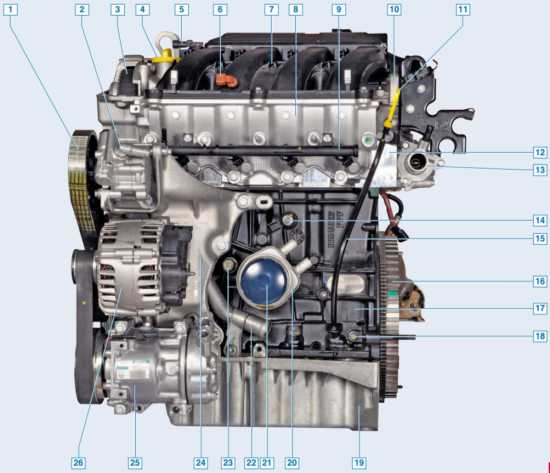
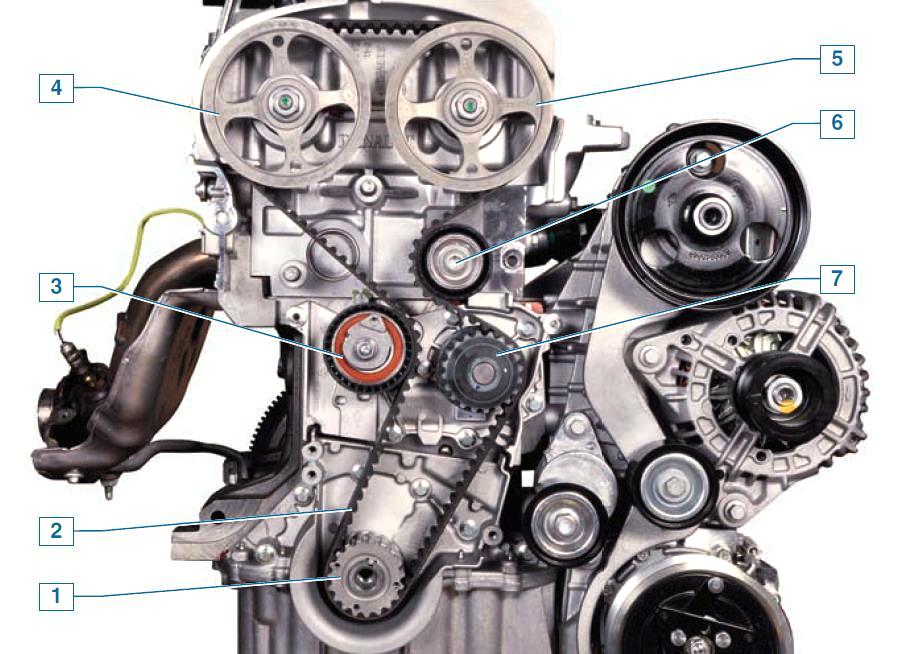
Renault Duster 2.0 engine (front view in the direction of vehicle movement): 1 - drive belt for additional units; 2 - power steering pump; 3 - timing belt; 4 - oil filler cap; 5 - absolute air pressure sensor; 6 - intake air temperature sensor; 7 - receiver; 8 - supply hose; 9 - fuel rail with injectors; 10 - cylinder head cover; 11 - oil level indicator; 12 - cylinder head; 13 - thermostat; 14 - knock sensor; 15 - guide tube of the oil level indicator; 16 - flywheel; 17 - cylinder block; 18 - cork; 19 - oil pan; 20 - heat exchanger; 21 - oil filter element; 22 - inlet pipe of the coolant pump; 23 - sensor of the indicator of unsatisfactory oil pressure; 24 - bracket for additional units; 25 - air conditioning compressor; 26 - generator

Power unit 2.0 of a Renault Duster car (rear view in the direction of the car's movement): 1 - coolant temperature sensor; 2 - cylinder head; 3 - left eye of the engine; 4 - cylinder head cover; 5 - receiver; 6 - throttle assembly; 7 - right eye of the engine; 8 - top cover of the timing drive; 9 - lower cover of the timing drive; 10 - drive belt for additional units; 11 - cylinder block; 12 - exhaust manifold; 13 - oil pan; 14 - guiding oxygen concentration sensor
Renault Duster cars are equipped with engines of 2 modifications: K4M with a volume of 1.6 liters and F4R with a volume of 2.0 liters. Both engines are gasoline, four-stroke, four-cylinder, in-line, sixteen-valve - with an overhead arrangement of 2 camshafts. The motors are placed transversely in the engine compartment. By design, the motors are similar to
each other. The main differences are related to the volumes of the parts of the crank mechanism, since the cylinder diameters and piston strokes of the motors are different. The order of operation of the cylinders: 1-3-4-2, counting - from the flywheel. The power system is a staged multi-point fuel injection (Euro-4 toxicity standards). Renault Duster engine with gearbox and clutch
represent the engine - a solid block, fixed in the engine compartment on 3 flexible rubber-metal supports. The right support is attached to the top cover of the gas distribution mechanism drive (timing) of the power unit, and the left and rear ones are attached to the gearbox housing. On the 2.0 engine, a valve timing control system is used, which consists in changing

The power unit 2.0 of a Renault Duster car (view from the right side in the direction of movement of the car): 1 - the upper cover of the timing drive; 2 - throttle assembly; 3 - absolute air pressure sensor; 4 - receiver; 5 - timing belt; 6 - oil filler cap; 7 - the actuator of the system for changing the phases of the timing; 8 - lower cover of the timing drive; 9 - fuel rail with injectors; 10 - pulley of the power steering pump; 11 - generator pulley; 12 - electromagnetic clutch of the air conditioning compressor; 13 - support roller for the drive belt of additional units; 14 - roller of the tensioning mechanism of the drive belt of additional units; 15 - drive belt for additional units; 16 - oil pan; 17 - drive pulley for additional units; 18 - cylinder block; 19 - exhaust manifold

The actuator of the variable valve timing system of the Renault Duster 2.0 engine is located on the toe of the intake camshaft and is combined with a toothed pulley of the shaft.
Source: http://avtorial.ru/Renault/Renault_Duster-24.html